Nobody Owned This Shipwreck — Not the State, Not the Feds, Not Even the Sea
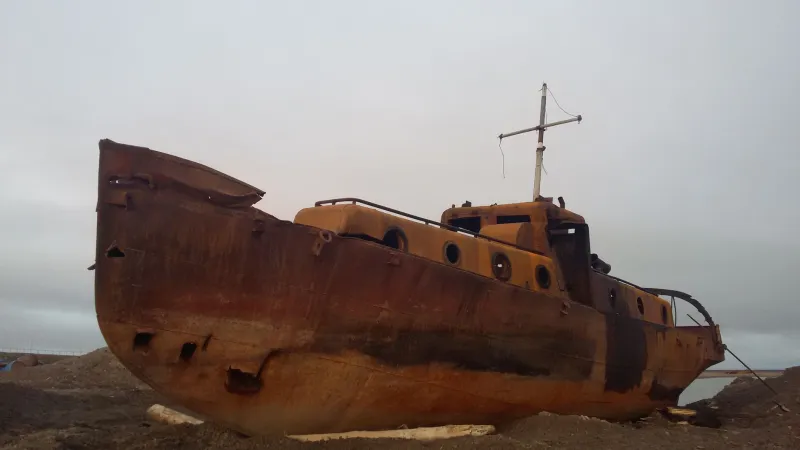
There are things in this world that are so obviously, physically present that the idea of them existing in legal limbo seems almost absurd. A mountain. A building. A two-hundred-foot steel-hulled cargo ship sitting on a beach.
And yet.
Sometime in the early twentieth century, a vessel ran hard aground on a stretch of American coastline and proceeded to become one of the strangest legal puzzles in the history of maritime property law. It sat there — rusting, enormous, impossible to ignore — while lawyers, bureaucrats, federal judges, and state officials spent the better part of five decades failing to agree on a single, basic question: whose problem was this?
How a Ship Becomes Nobody's Property
To understand how something this large could fall through the legal cracks, you need to understand how maritime law actually works — or more precisely, how it fails to work when multiple jurisdictions are all technically correct and mutually incompatible.
When a vessel is wrecked in American coastal waters, at least three distinct legal frameworks immediately assert themselves. Federal admiralty law governs the ship as a vessel and has jurisdiction over salvage rights. State law governs the land beneath and around it, including any tidal zones or beaches where the wreck might rest. And international maritime conventions, to which the United States was a signatory, introduced their own set of rules about abandoned vessels and the rights of the original owner's nation of registry.
In most wrecks, one framework wins cleanly. The ship sinks in deep federal waters and admiralty law takes over. Or it washes onto private land and the property owner's claim is straightforward. Or the original owner files a timely claim and retains legal title while selling salvage rights.
This particular wreck managed to satisfy none of those clean outcomes. It came to rest in a tidal zone — land that is alternately submerged and exposed, and which exists in a genuinely ambiguous legal space between state ownership and federal jurisdiction. The ship's country of registry had dissolved as a political entity in the aftermath of World War I, leaving no government capable of filing an ownership claim. And the American company that had been contracted to carry the cargo had gone bankrupt before anyone could serve them with a legal notice.
 Photo: World War I, via cdn.thecollector.com
The wreck was, in the most technical sense possible, ownerless.
The Squatters Who Saw an Opportunity
Nature abhors a vacuum, and so apparently do certain enterprising coastal residents.
At some point in the 1920s, a small number of people began treating the wreck as something between a landmark and a residence. The hull, though deteriorating, remained structurally intact enough in several sections to provide shelter. Locals began using it for storage. Fishermen tied up to it. At least two families, according to regional newspaper accounts from the period, appear to have actually lived inside sections of the ship for stretches of time during the Great Depression, when housing options were limited and nobody was in a position to evict them from something that didn't legally belong to anyone.
 Photo: Great Depression, via about-history.com
State authorities made occasional noises about removing the squatters but consistently ran into the same problem: doing so would implicitly assert state ownership of the wreck, which would then obligate the state to do something about the wreck itself. Removal of a vessel that size was expensive. The state declined to own the problem.
Federal authorities had a mirror-image version of the same headache. The Coast Guard had jurisdiction over navigational hazards, and the wreck was technically in a position where it could be argued to pose a risk to small watercraft. But asserting that jurisdiction would put the federal government on the hook for cleanup costs that nobody in Washington wanted to authorize.
So the squatters stayed. The wreck rusted. And the legal standoff continued.
The Court Ruling That Resolved Nothing
By the late 1940s, the wreck had become something of a local institution — featured on postcards, painted by regional artists, and visited by curious tourists who made it a stop on drives up the coast. It had also become increasingly dangerous, with sections of the hull collapsing and the whole structure settling deeper into the tidal sand.
A federal district court finally took up the question of jurisdiction in a case that had been working its way through the system for several years. The ruling, when it came, was a masterpiece of judicial hedging. The court determined that the wreck was indeed a navigational hazard within federal jurisdiction, that the tidal land beneath it fell under state authority, and that the cost of removal should be shared between federal and state agencies according to a formula that the court declined to specify, leaving that determination to future negotiation between the parties.
In practical terms, this resolved almost nothing. The state and federal governments spent another several years arguing about the cost-sharing formula. The wreck continued to deteriorate. By the time a removal contract was finally awarded, much of the hull had already collapsed into the sand, and the actual removal effort was a fraction of what it would have cost two decades earlier.
What the Wreck Left Behind
The physical ship is long gone now — dragged away in pieces, sold for scrap, and absorbed into the great anonymous mass of recycled steel that built mid-century America. The beach where it sat has been reclaimed by the tidal processes that were always going to win eventually.
What remains is the legal record, which maritime historians occasionally cite as a particularly clear illustration of what happens when overlapping jurisdictions fail to coordinate. The wreck has appeared in law school curricula as a case study in the limits of admiralty law and the dangers of jurisdictional ambiguity in tidal zones.
And somewhere in the regional archives of at least two coastal states, there are boxes of correspondence — letters between state attorneys general and federal solicitors, memos from Coast Guard administrators, petitions from local residents — all circling the same unanswerable question with increasing frustration.
The ship was right there. Everyone could see it. Nobody could touch it.
That's the thing about legal limbo. It doesn't require invisibility. Sometimes the most untouchable things are the ones sitting in plain sight on a public beach, rusting quietly in the salt air while the lawyers argue.