The Word That Wasn't: How One Typo in a 1920s Dictionary Fooled the English Language for Decades
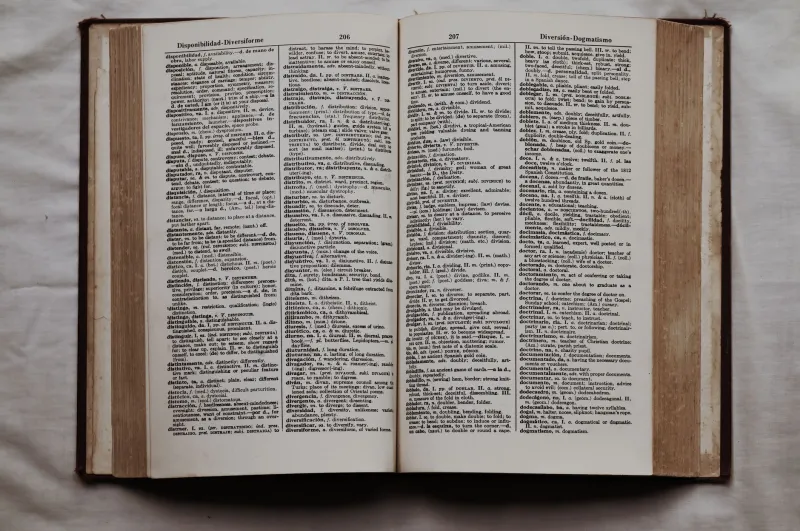
There's a version of this story that sounds like something out of a linguistics thriller. A single keystroke error, buried deep inside a reference book that millions of Americans treated as gospel, quietly escaped into the wild. It got reprinted, re-cited, and repeated until it stopped being a mistake and became, by most practical definitions, correct. The word that never should have existed had become real — because enough people believed it was.
This is what happens when a typo gets too popular to die.
The Book That Built the Language
To understand how a dictionary error could carry this kind of weight, you have to understand what dictionaries meant to Americans in the early twentieth century. This wasn't the age of spell-check or quick Google searches. For writers, teachers, lawyers, and journalists, a major dictionary wasn't just a reference tool — it was an authority. If the book said a word was spelled a certain way, that was the spelling. End of discussion.
Merriam-Webster, in particular, had cemented itself as the definitive standard for American English by the time the 1920s rolled around. Their editions were used in courtrooms, newsrooms, and classrooms from coast to coast. When a new edition came out, publishers updated their style guides to match. Newspapers changed their house rules. Schools revised their spelling curricula.
Which made what happened next especially remarkable.
One Letter, Enormous Consequences
Somewhere in the production process of a major dictionary edition during the 1920s — through typesetting, proofreading, or simple human error — a word got mangled. The specifics vary depending on which linguistic historian you ask, but the general pattern is well-documented: a misspelling slipped past editors, landed in print, and because the book carried such institutional authority, downstream publications simply copied it without question.
Style manuals cited the dictionary. Textbooks cited the style manuals. Newspapers cited the textbooks. Within a generation, the misprint had propagated through American written English so thoroughly that writers who spelled the word correctly — according to its original etymology — started getting marked wrong by editors who were working from sources that traced back, unknowingly, to that single production error.
The word itself was unremarkable. It wasn't a flashy term or a technical one. It was the kind of everyday word that appears in ordinary sentences, which is precisely why the error spread so efficiently. Nobody was scrutinizing it. It just... traveled.
When the Experts Started Fighting
By the mid-twentieth century, the discrepancy had become impossible to ignore in academic circles. Etymologists tracing words back to their Latin or Greek roots kept running into a mismatch. The spelling that had become standard in American usage didn't align with the word's documented history. Someone had gotten something wrong, and the trail led back to that 1920s printing.
What followed was the kind of argument that only language scholars can sustain for decades without either side surrendering. On one side: purists who argued that correct spelling is anchored to a word's origins, and that a typo — no matter how widely reproduced — doesn't become legitimate simply through repetition. On the other side: descriptivists who pointed out that language is defined by actual usage, and that if millions of educated writers were using a particular spelling consistently, then that spelling had effectively become correct, regardless of how it started.
Both positions were entirely defensible. That was the problem.
The Uncomfortable Truth About Dictionaries
Here's the part that tends to unsettle people who grew up treating dictionaries as the final word on, well, words: dictionaries don't create language. They document it. And when what they document is itself based on an error that has since become widespread, the feedback loop gets genuinely weird.
A dictionary records how people use words. People use words based partly on what dictionaries tell them. If a dictionary records a mistake, and people adopt the mistake, the next edition of the dictionary records the mistake as standard usage. At some point in that cycle, the mistake stops being a mistake. It's a process that makes perfect logical sense and still feels deeply unsatisfying.
The misprinted word eventually appeared in enough editions, across enough publishers, that the "wrong" spelling accumulated more documented usage than the "right" one. Prescriptivists gnashed their teeth. Descriptivists shrugged and updated their notes.
The Correction That Wasn't Really a Correction
When dictionary editors finally addressed the discrepancy in later decades, they didn't simply swap one spelling for the other. Instead, most major reference works did something that managed to satisfy almost nobody: they listed both versions as acceptable, noting the historical origin of the variation. The "correct" spelling from an etymological standpoint got a footnote acknowledging it was technically the original. The "incorrect" spelling got listed as the primary American English standard.
In other words, the typo won. Sort of. With an asterisk.
Language scholars still debate whether that resolution was intellectually honest or a convenient capitulation to the sheer volume of the error's propagation. The answer probably depends on whether you believe a word's meaning lives in its history or in its current use — a question linguists have been arguing about since long before any of this happened.
Why This Still Matters
In the age of digital publishing, this kind of error would theoretically be easier to catch and correct. Search-and-replace functions exist. Style databases get updated in real time. But the broader lesson from the 1920s dictionary incident hasn't gone anywhere: authoritative sources make mistakes, and when those mistakes are trusted rather than questioned, they compound. The more prestigious the source, the faster the error travels.
The next time you're absolutely certain something is spelled correctly because you've always seen it spelled that way — it might be worth asking where, exactly, "always" started.