When Chasing Cattle Through a Blizzard Led to America's Greatest Archaeological Find
The Worst Day to Chase Livestock
Picture this: You're a dentist in small-town Colorado, it's December 1901, and one of your cows has decided to wander off into a snowstorm. Most reasonable people would write off the cow and wait for spring. Dr. Frederic Willcox was apparently not most people.
What happened next sounds like the setup to a joke about how archaeological discoveries really work. Willcox, along with his neighbor Charlie Mason, spent hours trudging through knee-deep snow across Mesa Verde's treacherous terrain, following cattle tracks that were rapidly disappearing under fresh powder. They were cold, frustrated, and probably questioning every life choice that had led them to this moment.
Then Willcox looked up.
When Reality Hits Different Than Expected
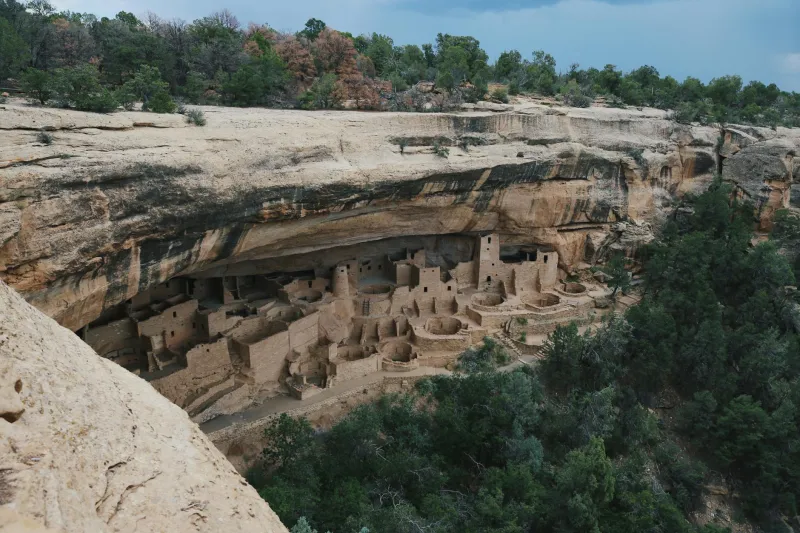
Through the swirling snow, carved into the cliff face like something from a fever dream, was an entire ancient city. Not ruins scattered on the ground, not a few pottery shards, but a complete, perfectly preserved cliff dwelling with multi-story buildings, ceremonial chambers, and intricate stonework that had been sitting there, untouched, for over 600 years.
Willcox later described the moment as "like looking into another world." Which, considering he'd been expecting to find a cow and instead discovered one of the most significant archaeological sites in North America, seems like a reasonable reaction.
What they'd stumbled onto was Cliff Palace, the largest cliff dwelling in Mesa Verde and home to the Ancestral Puebloan people who had built an entire civilization into these canyon walls between 1190 and 1300 CE. The structure contained over 150 rooms and could house roughly 100 people, complete with sophisticated water management systems and storage facilities that had kept perfectly preserved corn cobs fresh for centuries.
The Civilization Nobody Knew Was There
The Ancestral Puebloans (formerly called the Anasazi) had created something extraordinary in these Colorado cliffs. They'd carved entire communities into rock faces, developed complex agricultural systems in one of the harshest environments in North America, and built structures so sophisticated that modern engineers still study their techniques.
But here's the thing that makes Willcox's discovery so remarkable: nobody in the outside world knew any of this existed. Local Ute tribes had known about the ruins for generations, but the broader American public and scientific community were completely unaware that an advanced civilization had flourished in these canyons for over a century.
The Ancestral Puebloans had mysteriously abandoned Mesa Verde around 1300 CE, likely due to a combination of drought, resource depletion, and social upheaval. They'd left behind not just Cliff Palace, but hundreds of other structures throughout the area, creating what was essentially an open-air museum of pre-Columbian American life.
From Dental Practice to National Monument
Willcox, to his credit, immediately understood the significance of what he'd found. Instead of looting the site or keeping quiet about it, he began documenting everything he could find and spreading word about the discovery. He and Mason explored the ruins extensively, photographing and cataloging artifacts with the kind of methodical approach you'd expect from someone whose day job involved precise handiwork.
Their documentation efforts proved crucial because Cliff Palace quickly attracted the attention of serious archaeologists and, unfortunately, artifact hunters who were less concerned with preservation than profit. The site's remote location had protected it for centuries, but once word got out, it needed official protection.
Thanks partly to Willcox's advocacy and documentation, President Theodore Roosevelt designated Mesa Verde as a national park in 1906, making it the first national park created specifically to preserve archaeological sites. Today, Mesa Verde National Park protects over 5,000 archaeological sites, including 600 spectacular cliff dwellings.
The Cow That Changed History
Here's the beautiful absurdity of the whole situation: we have no record of whether Willcox ever found that cow. Historical accounts focus entirely on the archaeological discovery, leaving the original motivation for the trek completely unresolved. One of America's most important cultural heritage sites was discovered during what was essentially a really bad day of ranch work.
Willcox returned to his dental practice, but he'd inadvertently triggered a complete reevaluation of pre-Columbian American civilization. His accidental discovery proved that sophisticated societies had thrived in North America long before European contact, fundamentally changing how Americans understood their own history.
The next time someone tells you that great discoveries require careful planning and systematic research, remind them about the dentist who found Cliff Palace while chasing livestock through a blizzard. Sometimes the most important moments in history happen when you're just trying to get your cow back before dinner.